
I’m sorry I’ve not blogged for a while.
If I’m honest, I’ve not been well.
You see, it seems I’ve been suffering from the chronic and little known condition called,
“Detachment-itis”…
…and the only cure is to have him home.

Detachment-itis
Detachment-itis is a painful condition that affects military families world wide.
There are a number of variants, and the symptoms of these will be described in more detail below.
Pre-detachment-phobia
The day you become infected;
- heart rate increases
- palms become sweaty
- panic sets in

You may notice an increased desire to throw stuff, or cry.
After this extreme allergic reaction to the news your partner is going away, expect to experience an uncontrollable instinct to re-arrange plans.
The sufferer will go into a state of limbo, where life carries on as normal but nothing is normal at all; planning for a temporary future, where one of you is missing.

Headless chicken syndrome (HCS)
You are at your most contagious shortly before departure and this is when your partner is most likely to become infected.
HCS may cause them to behave in all sorts of unusual ways, commonly displaying some or all of the following symptoms.
- racing about muttering phrases such as “clearance chit”, “stores were closed” and “where’s my passport?”
- bags may be dragged from under beds and from out of the lofts you’re not supposed to use
- the kit of yesteryear is compared with newly issued kit, and the new kit becomes discarded as “crap”, cast aside in the pile of military issued items they’ll never wear.
- they begin to place orders on amazon for items they will never fit in their kit bag, including enough toiletries to stock a whole aisle in Superdrug.
- they make important piles in every room of the house, which thoroughly upsets animals who know “something’s up!”
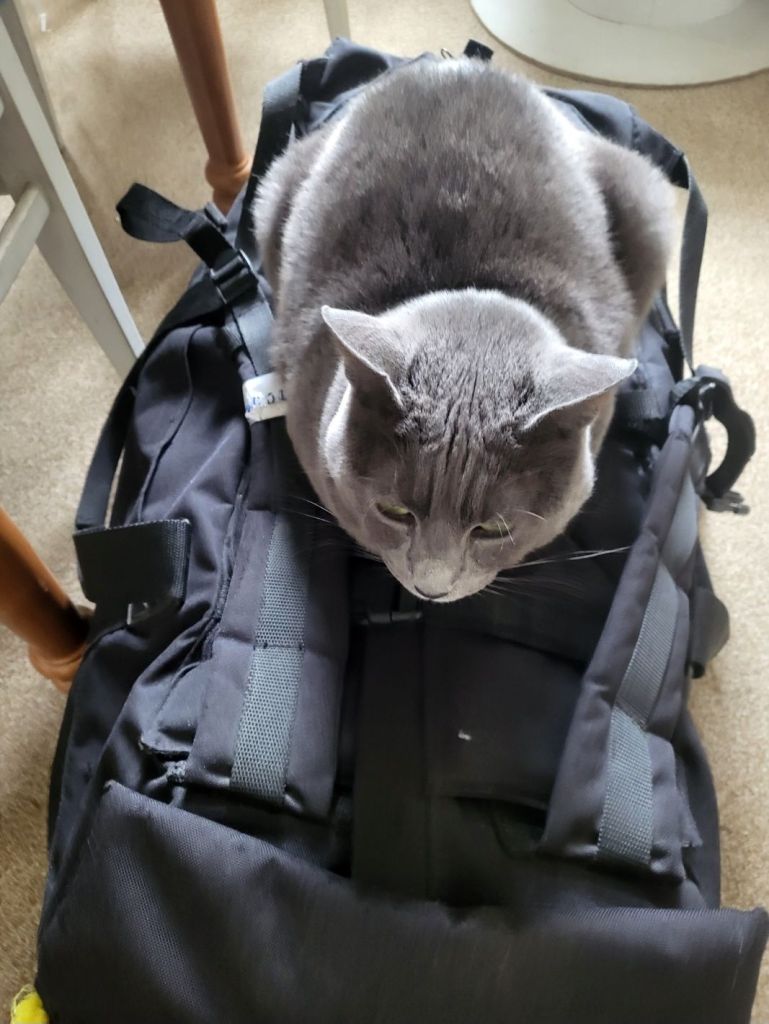
And thus the family moves into the most aggressive stage of the disease.
Can-we-just-get-on-with-it-osis
This manifests as a dire need to get on with the detachment. It affects 8 out of 10 families, and is a classic self preservation symptom.
During this phase, people begin to change their mind set from:
“I don’t want you to go”
to
” I wish you’d just leave so I can get on with summer“
Departure Pox
The serving partner finally leaves; be it by ship, jet plane or road.
That last few hours is always a sobering affair. An immense wave of sadness commonly passes over everyone infected as they huddle together, savouring the last few moments before departure.

The door quietly closes.
Tinnitus
A sudden and constant ticking can now be heard in the inner ear. Do not be too alarmed if this occurs; its just a ticking clock.

“The countdown has begun”.
While the sufferer may now be fully focussed on managing their new situation, complications can arise. Sufferers may experience some of the following symptoms:
Obsessive compulsive spring-cleaning disorder (OCSD)
Sufferers of OCSD may find it hard to control their urge to purge. A flurry of activity may ensue in those first few days/weeks. Some may instantly start attacking the house, rearranging stuff, spring-cleaning (in November).

They can be found emptying cupboards, filling bags for charity, selling items on Vinted and then spending it all on Amazon buying more stuff they don’t need.
Obsessive compulsive binging disorder (OCBD)
This may result in the sufferer binge watching Netflix and gorging on pizza and Ben and Jerrys ‘Phish Food’ for several weeks/months.

In later stage detachment-itis the sufferer may likely respond to their OCBD by buying a rowing machine and living off avocados and cottage-cheese.
Huge burden syndrome
The military spouse suddenly find themselves responsible for all things, filling the gap their partner left behind. They must get to grips with all those roles and responsibilities they didn’t even know their partner did, and become experts at them immediately to avoid the world collapsing. Its a huge burden.

In addition to this excess of responsibility, comes the unhappy fact, that things will inevitably start to go “bums up“.
At this point the average separated military family will experience one, or multiple, of the following symptoms.
Everything’s falling apart-itis
This could be anything from a broken appliance, to your boiler exploding, toilet overflowing, window falling off, or water pouring through a light bulb.

Whichever of these it may be, there comes with it, a guarantee, that it won’t be fixed for at least 7 weeks. You may find yourself without heating or clean water but that’s ok….
Pinnacle will send the wrong engineer out to look at it 3 times and on the 4th time the right engineer will turn up wielding the wrong part.
Man-down-ia
The lurgy can be a frustrating, repetitive cycle for families, everyone catching it, but not at the same time. For partners without kids, it entails a lonely existence of suffering quietly in bed with no one to make you buttery toast and mop your sweaty brow.

If you are finding the lurgy phase of Man-down-ia tedious, why not throw in a couple of broken ribs or concussion to liven things up?
Child gone rogue Mania
He’s missing his missing parent. He’s been up every night for the last 6 weeks screaming for them and pushing you away, and to add insult to injury he now no longer eats vegetables. You’ve had 6 calls from school this week saying he’s bitten 3 friends and a teacher and this morning he’s cleverly written his name for the first time on the quarter carpet with a bright purple sharpie pen.

Acute Sick Pet-osis
If you are the owner of a 4 legged pet friend, you can be certain they will wait for the separation period to begin before falling victim of an injury that turns them into a 3 legged pet friend.

Or they may just cleverly break into your partners lovingly packaged Christmas welfare box and snaffle half a box of after eight mints. No one knows which it will be, but you can guarantee it will happen.
Chronic Car Died Syndrome
Some unfortunate military spouses will fall victim to this cruel turn of events. You may find yourself huddled on a grass verge in the dark with 3 under 5’s (one who isn’t yours), waiting for the infamous 4th emergency service not to arrive. It is likely you will be spending several weeks wheel-less while you wait for a backlog of parts to ship from Timbuctoo.
What the sufferer may not be aware of is that these symptoms can literally consume a whole detachment. Your Dr may recommend trying a course of light relief pills to see if any of your symptoms alleviate.
Light relief pills
It is helpful for recovery to have periods of light relief with family and friends no matter how guilty you may feel about having fun without your partner.

At the end of the day, detachment-itis or no detachment-itis, life has to carry on.
Homecoming-Euphoria Tourette’s
At the time of releasing the long awaited homecoming date, a home-front parent will probably ponder the number of times that plans have already changed. This being the case, they may attempt to ask their partner the question…
“Is it sensible to tell the children when you’re coming home?”
But before the words have fully left their lips, the partner TELLS the kids when they’re coming home.
They can’t help it. Homecoming-Euphoria Tourette’s has taken its toll.
If this does happen to you, you may want to apply some “don’t get too excited ointment” (available on prescription). Of course, you won’t use it for long; because that ticking tinnitus is giving it some pretty large beans in your brain, and you are just SO READY to have them back.

I’m going to end this symptom sorter on a positive note
Your partner arrives home exactly as planned (although we all know that nine times out of ten this will NOT be the case)!
It’s been a long, hard slog for all of you, your partner included. Detachment-itis affects them too, but in different ways, and it’s often hard for a military spouse to understand that, especially when you’re the one left behind.
But look at you! Your fort is still standing (just), everyone is unscathed (mostly) and it will soon start to feel like a distant bad dream.
If you are now in the recovery period yourself, please remember to take it easy. You’ve had a rough ride.
This is a brutal condition that takes its toll on body, mind, and soul, and the healing process can be slow. So relax, enjoy each other, and try to refrain from asking your partner after two weeks of living with their kit piles, boots and bags…
“When are you off again”?
Make the most of every moment you can because catching Detachment-itis once doesn’t mean you’re immune. It will inevitably catch you again one day, when you least expect it.

A note from me to you:
I find it therapeutic to look for the ridiculous in our everyday lives, and let’s face it, there is nothing more ridiculous than the lives we lead as military spouses.
I’m currently drawing to the end of a very long 6 months apart from my husband and it got me to thinking about how those rollercoaster experiences we go through as husbands, wives and families, affect us day to day.
20+ years hanging around the military has taught me to laugh at some of the bonkers situations we find ourselves in. I have dedicated this blog to all those men, women and children who have inspired this little bit of fun with their own survival stories.
Thank you for sharing the best and worst parts of your lives with me.
I hope I’ve done you and your amazing strength some justice 🥰
Photo credits
Lady on bed – Photo by Andrea Piacquadio on Pexels.com, Panic attack – Photo by SHVETS production on Pexels.com, Jigsaw – Photo by Mike van Schoonderwalt on Pexels.com, Man with baby – Photo by Mary Nikitina on Pexels.com, Lady cleaning – Photo by cottonbro studio on Pexels.com, Man eating Pizza – Photo by Ron Lach on Pexels.com, Man in red Tshirt – Photo by Andrea Piacquadio on Pexels.com, Toilet – Photo by Enrico Hu00e4nel on Pexels.com, Sick lady – Photo by cottonbro studio on Pexels.com, Child – Photo by Keira Burton on Pexels.com, Pill – Photo by JESHOOTS.com on Pexels.com Dog – Photo by mazzy Fritzel on Pexels.comStethoscope – Photo by Photo By: Kaboompics.com on Pexels.comFamily – Photo by Keira Burton on Pexels.com

 Welcome to My Blog